Showing posts with label current events. Show all posts

Friday, April 30, 2010

conversations with god


this week the oklahoma legislature overrode governor brad henry's veto of two abortion measures, which means the measures took immediate effect.

one of the bills requires women to undergo an ultrasound and listen to a detailed description of the fetus before getting an abortion. the other measure prohibits pregnant women from seeking damages if physicians withhold information or provide inaccurate information about their pregnancy.

this isn't going to be a blog about the pro-choice vs. pro-life debate. i've thought long and hard about that issue, and since there's no chapter on gestational age and the soul in the bible, i went straight to the source and asked god when the soul enters a fetus. he in his infinite wisdom replied, "[silence]."

now i could be wrong, but unless stephen hawking has created some magical telephone to the afterlife available only to the pope and planned parenthood and the oklahoma legislature, then i'm pretty sure that everyone has received the same response from the almighty: nada. so i'm not interested in discussing the right or wrong of it with anyone who doesn't have irrefutable proof, and until then, i'm not taking part in the abortion debate--and frankly, i don't think anyone else should be debating it, either, except between themselves and god. who won't answer, by the way. frustrating, no?

but back to these bills. what i find interesting--and i don't like to generalize about the right or the left because i myself am all over the place--but what i find interesting is that the same people who are vehemently protesting obama's "death panels" regarding physician guidance on end-of-life discussions are the same ones who are supporting the oklahoma legislature's required physician guidance on end-of-pregnancy discussions.

now, wait. what? you can't have it both ways. either the government is in the exam room, or they aren't. you can't pick and choose to suit your cause.

i'm appalled that the legislature thinks it's okay to dictate how doctors communicate with their clients. these requirements that doctors engage abortion patients in lengthy conversations about the fetus so that women can be "informed" about their choice to end a pregnancy: where is the requirement that doctors engage pregnancy patients in lengthy conversations about the cost of raising a child to adulthood, and carbon footprints, so that a woman can be "informed" about their choice to carry a pregnancy to term? the whole concept is woefully imbalanced. women can inform themselves just fine.

i mean, what's next?

before we can perform your hysterectomy to save you from potentially fatal cancer we are required by law to count how many viable eggs you are going to be throwing away as medical waste, and we have to show it to you on an ultrasound and read you this script drafted by your state legislature.

before we can perform your masectomy to we are required by law to show you a film about why it's best to breastfeed your baby so that you are fully aware of all potential drawbacks to this procedure recommended by your oncologist.

does the legislature think we're all idiots??

and i think it's even more abhorrent that this legislation allows doctors to outright lie to their patients about the condition of their pregnancy if the physician thinks that the information might cause a woman to seek an abortion. are you insane, oklahoma legislature??? i can't even communicate how repugnant this premise is. that's barbaric.

the bottom line for me: the government shouldn't be placing ANY requirements on how doctors talk to their patients - about life, death, or anything in between. and it shouldn't protect doctors from lying or misleading patients about real medical issues. these things should be left to the oklahoma and american medical associations who have actual medical knowledge--not just a bunch of morally ambiguous suits up at the capitol lunching on smoked salmon and making judgments about the decision-making abilities of intelligent adults they've never met.

i hope all of you understand how important it is that this legislation be overturned - and it will, it's blatantly unconstitutional. this has nothing to do with whether or not abortions are immoral or criminal, and everything to do with interfering in the doctor/patient relationship. the implications of this legislation are far-reaching: i'm not planning to seek an abortion, but i am planning to have another baby at some point, and this legislation allows my doctor to arbitrarily withhold crucial information from me about my pregnancy and the health of my unborn child.

EVERYONE should be frightened by this.

Friday, October 3, 2008

Tuesday, September 23, 2008

poll

bill moyers over at PBS has a poll posted on his site today asking, "do you think sarah palin is qualified to be vice president of the united states?"

mosey on over and vote.

edited to fix link.  
thank you erin and carrie.  
and thank you mark for your always acerbic commentary.

Friday, September 5, 2008

bristol's choice

republicans and the illusion of reproductive choice
by dahlia lithwick, slate.com

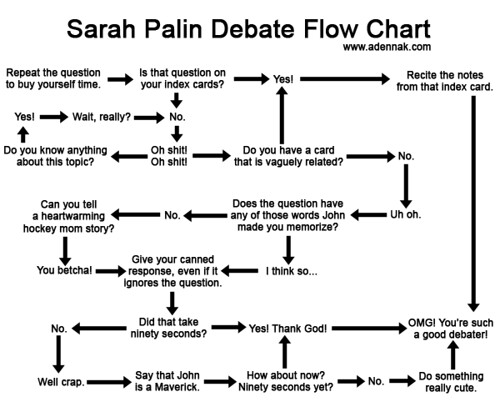
In announcing that her 17-year-old daughter was pregnant this week, GOP vice-presidential hopeful Sarah Palin used this puzzling locution: "We're proud of Bristol's decision to have her baby." Pundits were quick to point out that Bristol's "decision" must have been at least somewhat constrained by her mom's position—as articulated in November 2006—that she would oppose an abortion for her daughters, even if they had been raped. Palin is an outspoken advocate of parental veto; she called the Alaska Supreme Court's recent decision to strike down that state's parental-consent statute "outrageous." So what exactly, one wonders, was young Bristol permitted to decide?

John McCain led us through this same hall of mirrors in 2000 when asked what he would do if his then-15-year-old daughter, Meghan, were pregnant. "The final decision would be made by Meghan with our advice and counsel," he said at the time. Yet McCain also says that "Roe v. Wade is a flawed decision that must be overturned" and told Tim Russert he favors "a constitutional amendment to ban all abortions." The GOP ticket may want to preserve the illusion that their daughters get to do the deciding, but the GOP platform would bar these women from choosing to have an abortion, even if the pregnancy resulted from rape or incest. John McCain has pledged to appoint Supreme Court justices who would overturn Roe.

There are legitimate reasons to differ over the morality of abortion. There is also a legitimate disagreement over the fitness of a 16- or 17-year-old to decide to terminate her pregnancy. So while the GOP position on abortion doesn't treat teenagers as grownups, it does show a growing inclination to treat grownup women as little girls. As important as the decision to end a pregnancy is, the matter of who gets to decide may be even more important. And that decision is increasingly being taken out of the hands of women and put into the hands of strangers.

In 1973, the Supreme Court decided in Roe v. Wade that the right of privacy "is broad enough to encompass a woman's decision whether or not to terminate her pregnancy." It was an announcement that women—in consultation with their doctors and subject to limitations—should be free to make this difficult choice themselves. When the court reaffirmed that principle in 1992, in Planned Parenthood v. Casey, it again acted to protect the liberty and autonomy of the women doing the choosing.

Today there is renewed doubt over whether grown women are fit to decide to abort a pregnancy at all. That is why Sarah Palin would not allow abortion in the event of maternal rape or a threat to maternal health but only with a "doctor's determination that the mother's life would end if the pregnancy continued." That is not the mother doing the deciding; it's her doctor. Presumably if they differ on this question, the mother loses.

And as we drift further down the road from Roe, it's clear we don't trust doctors anymore, either. That's why the South Dakota legislature forces physicians to read from a script before performing an abortion. Among other questionable declarations, physicians must now deliver the warnings that abortion leads to an increased risk of "depression and related psychological distress" and "suicide ideation and suicide." As Emily Bazelon has reported, most doctors delivering this warning do not believe it, as it is supported by dubious data. Nonetheless, the law went into effect in July, suggesting that legislators, not doctors, know what's best for women.

Justice Anthony Kennedy gave huge currency to the argument that women cannot be trusted with the decision to abort in his majority opinion in a 2007 decision banning a type of late-term abortion. Relying on yet more equivocal data, Kennedy lavished concern on women who regret their abortions, whose "distress" may someday lead to "severe depression and loss of esteem." It's a long road indeed from Roe when a woman's private choices about her future and her body are subordinated to Justice Kennedy's 20/20 psychological hindsight.

Which brings us to disturbing new regulations proposed by the Department of Health and Human Services—rules that ostensibly seek to protect the "right of conscience" of pharmacists and other health workers who don't want to participate in abortions. As William Saletan has argued, the current draft regulations—while an improvement upon the original—draw no explicit distinction between medical workers who refuse to provide abortions and those who oppose dispensing contraception. In these ambiguous cases the decision-maker may well be the medical-service provider herself, depending on what her own conscience permits. If these regulations go into effect, not only can your pharmacist refuse to give you the morning-after pill, he might deny you the month-before pill as well. At which point it's not just the judges, state legislatures, Supreme Court justices from Sacramento, or doctors who know better than women what's best for women. It's the pharmacist behind the counter, too.

Every time someone else in the decision-making chain gets the power to insert himself or herself and conscience between a woman and her fetus, the range of women's choices contracts. But women need not defer to anyone's "better" judgment when they pull the lever at the voting booth.

John McCain and Sarah Palin must pretend their daughters can make an autonomous decision about abortion with a little wise counsel. Yet both have also made it clear that they dream of an America in which all women—including Bristol Palin and Meghan McCain—may have a decision to make about an unintended pregnancy, but only one choice.

Tuesday, August 26, 2008

greatest quote ever

“If English was good enough for Jesus Christ, it ought to be good enough for the kids of Texas.”

- Miriam “Ma” Ferguson, former governor of Texas

courtesy of my fellow long-suffering attorney and red state resident mark

Tuesday, August 19, 2008

"at JFK airport, denying basic rights is just another day at the office"

by emily feder, alternet
august 18, 2008

I was recently stopped by Homeland Security as I was returning from a trip to Syria. What I saw in the hours that followed shocked and disturbed me.

I arrived at JFK Airport two weeks ago after a short vacation to Syria and presented my American passport for re-entry to the United States. After 28 hours of traveling, I had settled into a hazy awareness that this was the last, most familiar leg of a long journey. I exchanged friendly words with the Homeland Security official who was recording my name in his computer. He scrolled through my passport, and when his thumb rested on my Syrian visa, he paused. Jerking toward the door of his glass-enclosed booth, he slid my passport into a dingy green plastic folder and walked down the hallway, motioning for me to follow with a flick of his wrist. Where was he taking me, I asked him. "You'll find out," he said.

We got to an enclosed holding area in the arrivals section of the airport. He shoved the folder into my hand and gestured toward four sets of Homeland Security guards sitting at large desks. Attached to each desk were metal poles capped with red, white and blue siren lights. I approached two guards carrying weapons and wearing uniforms similar to New York City police officers, but they shook their heads, laughed and said, "Over there," pointing in the direction of four overflowing holding pens. I approached different desks until I found an official who nodded and shoved my green folder in a crowded metal file holder. When I asked him why I was there, he glared at me, took a sip from his water bottle, bit into a sandwich, and began to dig between his molars with his forefinger. I found a seat next to a man who looked about my age -- in his late 20s -- and waited.

Omar (not his real name) finished his fifth year in biomedical engineering at City College in June. He had just arrived from Beirut, where he visited his family and was waiting to go home to the apartment he shared with his brother in Harlem. Despite his near-perfect English and designer jeans, Omar looked scared. He rubbed his hands and rocked softly in his seat. He had been waiting for hours already, and, as he pointed out, a number of people -- some sick, elderly, pregnant or holding sobbing babies -- had too. There were approximately 70 people detained in our cordoned-off section: All were Arab (with the exception of me and the friend I traveled with), and almost all had arrived from Dubai, Amman or Damascus. Many were U.S. citizens.

We were in the front row, sitting a few feet from two guards' desks. They sneered at each bewildered arrival, told jokes in whispers, swiveled in their office chairs and greeted passing guards who stopped to talk -- guards who had a habit of looping their fingers into their holsters. One asked his friend how many nationalities were represented in the room. "About 20. Some of everything today."

No one who had been detained knew precisely why they were there. A few people were led into private rooms; others were questioned out in the open at desks a few feet from the crowd and then allowed to pass through customs. Some were sent to another section of the holding area with large computer screens and cameras, and then brought back. The uninformed consensus among the detainees was that some people would be fingerprinted, have their irises scanned and be sent back to the countries from which they had disembarked, regardless of citizenship status; others would be fingerprinted and allowed to stay; and the unlucky ones would be detained indefinitely and moved to a more permanent facility.

There was one British tourist in the group. Paul (also not his real name) was traveling with three friends who had passed through customs soon after their plane landed and were waiting for him on the other side of the metal barrier; he suspected he had been detained because of his dark skin. When he asked if he could go to the bathroom, one of the guards said, "I wouldn't." "What if someone has to?" I asked. "They will just have to hold it," the guard responded with a smile. Paul began to cry. I watched as he, over the course of four hours, went from feeling exuberant about his trip to New York to despising the entire country. "I speak the Queen's English," he said to me. "I'm third-generation British. I came to America because I've always wanted to come here, and now they've got me so scared that all I want to do is go home. We're paying for your stupid war anyway."

To be powerless and mocked at the same time makes one feel ashamed, which leads quickly to rage. Within a few hours of my arrival, I saw at least 10 people denied the right to use the bathroom or buy food and water. I watched my traveling companion duck under a barrier, run to the bathroom and slip back into the holding section -- which, of course, someone of another ethnicity in a state of panic would be very reluctant to do. The United States is good at naming enemies, but apparently we are even better at making them, especially of individuals. I don't know if it's worse for national security -- and more embarrassing for Americans -- that this is the first experience tourists have of our country, or that some U.S. citizens get treated this way upon entering their own country.

The guard who had been picking his molars for hours quietly mispronounced the names of people whose turn it was to be questioned, muttering each surname three times and then moving on. When he called Omar from City College to his desk, I moved closer to hear the interview. "Where did you go?" the officer asked. "What is your address in the United States? Is your brother here illegally? Do you support Hezbollah? What do you think of Hezbollah in general? How do you pay for your life here? How many people live with you? Are you sure it's just you and your brother? Who are your friends?" Omar answered respectfully and emphatically; he was then asked to wait by the side of the desk, from which he was ushered toward one of the rooms.

After four hours, I finally demanded to speak to the guards' supervisor, and he was called down. I asked if the detainees could file a formal complaint. He said there were complaint forms (which, in English and Spanish, direct one to the Department of Homeland Security's Web site, where one must enter extensive personal information in order to file a "Trip Summary") but initially refused to hand them out or to give me his telephone number. "The Department of Homeland Security is understaffed, underfunded, and I have men here who are doing 14-hour days." He tried to intimidate me when I wrote down his name -- "So, you're writing down our names. Well, we have more on you" -- and asked me questions about my address and my profession in front of the rest of the people detained. I pointed out a few of the families who had missed their flights and had been waiting seven hours. His voice barely controlled, his lip curled into a smirk, he explained slowly, condescendingly, that they need only go to the ticket counter at Jet Blue and reschedule so they could fly out in an hour. One mother responded with what he must have already known: Jet Blue goes to most destinations only once or twice a day and her whole family would have to sleep in the airport.

A large crowd began to gather. Everyone wanted to voice complaints. I explained to the supervisor that his guards had been making people afraid. He flipped through the green files, tossing the American passports to the front of the pile. "You should have gone first, before these people. American citizens first -- that's how it should be." In the face of dozens of requests and questions, he turned and left.

The guards processed me then, ignoring the order of arrivals, if there ever had been one. They refused to distribute more complaint forms or call the supervisor back down at the request of Arab families. One officer threatened, "I'm talking politely to you now. If you don't sit down, I won't be talking politely to you anymore." One announced that because "the American girl" had gotten angry, the families would have to wait a few more hours. "The supervisor is not coming back."

I reassured my Homeland Security interrogator that I did not make any connections with Hezbollah or with anyone I knew to be associated with such an organization. I am not a member of any terrorist group. In fact, my visit to Syria had been so apolitical and touristy that I felt an embarrassing affinity with the pastel-shirted families waiting by the Air France baggage carousels in the distance, whom I knew I would eventually join.

As I walked out of the enclosure, some people thanked me, squeezing my arm and putting their hands on my shoulders. It was shocking that briefly standing up to someone overseeing an abuse of civil rights -- in JFK airport, in the United States, where we supposedly have laws and a democratic judicial system -- could be perceived as heroic. I had nothing to lose, but the other people being detained had everything to lose.

In the past five years I have worked for human rights and refugee advocacy organizations in Serbia, Russia and Croatia, including the International Rescue Committee and USAID. I have traveled to many different places, some supposedly repressive, and have never seen people treated with the kind of animosity that Homeland Security showed that night. In Syria, border control officers were stern but polite. At other borders there have been bureaucracies to contend with -- excruciating for both Americans and other foreign nationals. I've met Russian officials with dead, suspicious looks in their eyes and arms tired from stamping so many visas, but in America, the Homeland Security officials I encountered were very much alive -- like vultures waiting to eat.

Thursday, August 14, 2008

Ill and in Pain, Detainee Dies in U.S. Hands

By Nina Bernstein
New York Times, August 12, 2008

He was 17 when he came to New York from Hong Kong in 1992 with his parents and younger sister, eyeing the skyline like any newcomer. Fifteen years later, Hiu Lui Ng was a New Yorker: a computer engineer with a job in the Empire State Building, a house in Queens, a wife who is a United States citizen and two American-born sons.

But when Mr. Ng, who had overstayed a visa years earlier, went to immigration headquarters in Manhattan last summer for his final interview for a green card, he was swept into immigration detention and shuttled through jails and detention centers in three New England states.

In April, Mr. Ng began complaining of excruciating back pain. By mid-July, he could no longer walk or stand. And last Wednesday, two days after his 34th birthday, he died in the custody of Immigration and Customs Enforcement in a Rhode Island hospital, his spine fractured and his body riddled with cancer that had gone undiagnosed and untreated for months.

On Tuesday, with an autopsy by the Rhode Island medical examiner under way, his lawyers demanded a criminal investigation in a letter to federal and state prosecutors in Rhode Island, Connecticut, Massachusetts and Vermont, and the Department of Homeland Security, which runs the detention system.

Mr. Ng’s death follows a succession of cases that have drawn Congressional scrutiny to complaints of inadequate medical care, human rights violations and a lack of oversight in immigration detention, a rapidly growing network of publicly and privately run jails where the government held more than 300,000 people in the last year while deciding whether to deport them.

In federal court affidavits, Mr. Ng’s lawyers contend that when he complained of severe pain that did not respond to analgesics, and grew too weak to walk or even stand to call his family from a detention pay phone, officials accused him of faking his condition. They denied him a wheelchair and refused pleas for an independent medical evaluation.

Instead, the affidavits say, guards at the Donald W. Wyatt Detention Facility in Central Falls, R.I., dragged him from his bed on July 30, carried him in shackles to a car, bruising his arms and legs, and drove him two hours to a federal lockup in Hartford, where an immigration officer pressured him to withdraw all pending appeals of his case and accept deportation.

“For this desperately sick, vulnerable person, this was torture,” said Theodore N. Cox, one of Mr. Ng’s lawyers, adding that they want to see a videotape of the transport made by guards.

Immigration and detention officials would not discuss the case, saying the matter was under internal investigation. But in response to a relative of Mr. Ng’s who had begged that he be checked for a spinal injury or fractures, the Wyatt detention center’s director of nursing, Ben Candelaria, replied in a July 16 e-mail message that Mr. Ng was receiving appropriate care for “chronic back pain.” He added, “We treat each and every detainee in our custody with the same high level of quality, professional care possible.”

Officials have given no explanation why they took Mr. Ng to Hartford and back on the same day. But the lawyers say the grueling July 30 trip appeared to be an effort to prove that Mr. Ng was faking illness, and possibly to thwart the habeas corpus petition they had filed in Rhode Island the day before, seeking his release for medical treatment.

The federal judge who heard that petition on July 31 did not make a ruling, but in an unusual move insisted that Mr. Ng get the care he needed. On Aug. 1, Mr. Ng was taken to a hospital, where doctors found he had terminal cancer and a fractured spine. He died five days later.

The accounts of Mr. Ng’s treatment echo other cases that have prompted legislation, now before the House Judiciary Committee, to set mandatory standards for care in immigration detention.

In March, the federal government admitted medical negligence in the death of Francisco Castaneda, 36, a Salvadoran whose cancer went undiagnosed in a California detention center as he was repeatedly denied a biopsy on a painful penile lesion. In May, The New York Times chronicled the death of Boubacar Bah, 52, a Guinean tailor who suffered a skull fracture and brain hemorrhages in the Elizabeth Detention Center in New Jersey; records show he was left in an isolation cell without treatment for more than 13 hours.

When Mr. Ng died last week, he had spent half his life in the United States, his sister, Wendy Zhao, said in a tearful interview.

Born in China, he entered the United States legally on a tourist visa. Mr. Ng stayed on after it expired and applied for political asylum. He was granted a work permit while his application was pending, and though asylum was eventually denied, immigration authorities did not seek his deportation for many years.

Meanwhile, his sister said, Mr. Ng (pronounced Eng), who was known as Jason, graduated from high school in Long Island City, Queens, worked his way through community technical college, passed Microsoft training courses and won a contract to provide computer services to a company with offices in the Empire State Building.

In 2001, a notice ordering him to appear in immigration court was mistakenly sent to a nonexistent address, records show. When Mr. Ng did not show up at the hearing, the judge ordered him deported. By then, however, he was getting married, and on a separate track, his wife petitioned Citizenship and Immigration Services for a green card for him — a process that took more than five years. Heeding bad legal advice, the couple showed up for his green card interview on July 19, 2007, only to find enforcement agents waiting to arrest Mr. Ng on the old deportation order.

Over the next year, while his family struggled to pay for new lawyers to wage a complicated and expensive legal battle, Mr. Ng was held in jails under contract to the federal immigration authorities: Wyatt; the House of Correction in Greenfield, Mass.; and the Franklin County Jail in St. Albans, Vt.

Mr. Ng seemed healthy until April, his sister said, when he began to complain of severe back pain and skin so itchy he could not sleep. He was then in the Vermont jail, a 20-bed detention center with no medical staff run by the county sheriff’s office. Seeking care, he asked to be transferred back to Wyatt, a 700-bed center with its own medical staff, owned and operated by a municipal corporation.

In a letter to his sister, Mr. Ng recounted arriving there on July 3, spending the first three days in pain in a dark isolation cell. Later he was assigned an upper bunk and required to climb up and down at least three times a day for head counts, causing terrible pain. His brother-in-law B. Zhao appealed for help in e-mail messages to the warden, Wayne Salisbury, on July 11 and 16.

“I was really heartbroken when I first saw him,” Mr. Zhao wrote Mr. Salisbury after a visit. “After almost two weeks of suffering with unbearable back pain and unable to get any sleep, he was so weak and looked horrible.”

The nursing director replied that Mr. Ng had been granted a bottom bunk and was receiving painkillers and muscle relaxants prescribed by a detention center doctor.

But his condition continued to deteriorate. Once a robust man who stood nearly six feet and weighed 200 pounds, his relatives said, Mr. Ng looked like a shrunken and jaundiced 80-year-old.

“He said, ‘I told the nursing department, I’m in pain, but they don’t believe me,’ ” his sister recalled. “ ‘They tell me, stop faking.’ ”

Soon, according to court papers, he had to rely on other detainees to help him reach the toilet, bring him food and call his family; he no longer received painkillers, because he could not stand in line to collect them. On July 26, Andy Wong, a lawyer associated with Mr. Cox, came to see the detainee, but had to leave without talking to him, he said, because Mr. Ng was too weak to walk to the visiting area, and a wheelchair was denied.

On July 30, according to an affidavit by Mr. Wong, he was contacted by Larry Smith, a deportation officer in Hartford, who told him on a speakerphone, with Mr. Ng present, that he wanted to resolve the case, either by deporting Mr. Ng, or “releasing him to the streets.” Officer Smith said that no exam by an outside doctor would be allowed, and that Mr. Ng would not be given a wheelchair.

Mr. Ng told his lawyer he was ready to give up, the affidavit said, “because he could no longer withstand the suffering inside the facility,” but Officer Smith insisted that Mr. Ng would first have to withdraw all his appeals.

The account of his treatment clearly disturbed the federal judge, William E. Smith of United States District Court in Providence, who instructed the government’s lawyer the next day to have the warden get Mr. Ng to the hospital for an M.R.I.

The results were grim: cancer in his liver, lungs and bones, and a fractured spine. “ ‘I don’t have much time to live,’ ” his sister said he told her in a call from Rhode Island Hospital in Providence.

She said the doctor warned that if the family came to visit, immigration authorities might transfer her brother. Three days passed before the warden approved a family visit, she said, after demanding their Social Security numbers. Late in the afternoon of Aug. 5, as Mr. Ng lay on a gurney, hours away from death and still under guard, she and his wife held up his sons, 3 and 1.

“Brother, don’t worry, don’t be afraid,” Ms. Zhao said, repeating her last words to him. “They are not going to send you back to the facility again. Brother, you are free now.”

Saturday, August 9, 2008

tell congress: rein in dhs travel abuses

by the American Civil Liberties Union
Direct Link

"With no suspicion and no explanation, the U.S. government can seize your laptop, cell phone, or PDA as you enter the United States and download all your private information -- including your personal and business documents, emails, phone calls, and web history. The Department of Homeland Security confirms that this is the official policy.

What happens if you refuse to let the agents download your personal photos? Or if you have encrypted your private information? Then Border Patrol -- which is now an agency of the Department of Homeland Security -- can simply copy your entire hard drive or even take your device and hang on to it indefinitely.

Unfortunately, seizing laptops and cameras at the border isn’t the only travel security measure that infringes on our civil liberties.

Just last month, the U.S. government's "terrorist watch list" surpassed one million names and is growing by over twenty-thousand names per month. The watch list includes the names of prominent people, like Senator Ted Kennedy (D-MA), plus hundreds of thousands of ordinary Americans -- many of them with common names like Robert Johnson and James Robinson. Your name might be on the list, but there's no way to know for sure until you are delayed -- or even detained for hours in a back room. If you discover your name is on the list, it's nearly impossible to get off. It actually took an Act of Congress to get Nelson Mandela off the list. No joke. An Act of Congress.

These abuses have something in common: They make all of us into suspects, with no rule of law and no accountability ... And recently, the TSA expressed interest in having every traveler wear an "electro-muscular disruption" bracelet that airline personnel or marshals could use to shock passengers into submission. Unless something is done, this plan may not be as far-fetched as one would think."

***

tell Congress to back off.  and congratulate me for making it on to the terrorist watch list by posting that ACLU link.  

oh, i kid, i kid. 

anyway, i'm virtually certain i'm already on there.  after all, i've enrolled in anti-death-penalty courses, and to make matters worse, i'm a democrat.  i voted for john! kerry!  you guys should just stop associating with me altogether before barack saddam hussein osama gets elected and we're all forced to start reading the koran.

Thursday, July 31, 2008

more on jim adkisson

this is an interesting current event to me because i am unitarian. anyhoo.

"Investigators described Adkisson as a former member of an Army airborne unit who trained as a mechanical engineer, but had been out of work since 2006. In a four-page letter found in his SUV, Adkisson expressed his belief that the Tennessee Valley Unitarian Universalist Church was a haven for liberalism in the typically socially conservative area of Eastern Tennessee."

Another news article described how he was frustrated at being unemployed and that he had found out his government aid and food stamps were being reduced, causing him to reach a breaking point. If I have time today I'll link back to it.

Now, correct me if I'm wrong here, but in the grand scheme of political ideologies, which party is more traditionally responsible for reducing government aid to the needy and social programs in favor of funnelling trillions of dollars overseas to, for example, protect private international oil interests? The liberals, is it? Riiiiight.

Obviously this guy's capacity to reason was staggeringly impaired, but it's just another example of the flawed and unsupported logic that people on both sides embrace in the liberals vs. conservatives battle. People: rise up and get informed. Please. I'm sick of the mudslinging-for-the-sake-of-mudslinging.

is killing liberals a hate crime?

Only in a few states.
By Chris Wilson, Slate.com
Wednesday, July 30, 2008
Direct Link

Tennessee church shooting suspect Jim David Adkisson, who confessed to opening fire in a Knoxville church last weekend, told police that he was motivated by a hatred for gays and liberals and, in particular, that "liberals should be killed because they were ruining the country." Authorities are now investigating the shooting as a hate crime. Do liberals get special protections under the law?

Not in Tennessee. The Volunteer State has two laws dealing with crimes motivated by hatred toward a particular group of people, but neither one specifies "political affiliation" or anything similar as a protected characteristic. The first law, Section 40-35-114 of the Tennessee code, allows a court to enhance the sentence for a crime committed because of the victim's "race, religion, color, disability, sexual orientation, national origin, ancestry, or gender." That could still apply to Adkisson, since he was targeting homosexuals as well as liberals, but any enhancement to his sentence might be superfluous: If convicted, he would likely face multiple life sentences or the death penalty. The second state law makes it a felony to intimidate someone for exercising his or her civil rights, and specifically mentions "race, color, ancestry, religion or national origin," leaving out both political and sexual orientation.

Just a handful of states designate political violence as a "hate crime." West Virginia makes it a felony to target a person because of "race, color, religion, ancestry, national origin, political affiliation or sex." Oregon includes labor unions as well, protecting "race, color, religion, national origin, sexual orientation, marital status, political affiliation or beliefs, membership or activity in or on behalf of a labor organization or against a labor organization, physical or mental disability, age, economic or social status or citizenship of the victim." The District of Columbia defines "bias-related crime" according to "race, color, religion, national origin, sex, age, marital status, personal appearance, sexual orientation, gender identity or expression, family responsibility, physical disability, matriculation, or political affiliation." Iowa also protects political affiliation, and the Louisiana code mentions "creed."(The federal government, like most states, does not include political affiliation in its definition of hate crimes.)

Actual prosecutions of hate crimes based on the victim's political affiliation are rare in the United States, according to legal experts. Annual crime compendiums from the individual states mentioned above occasionally categorize hate crimes as politically motivated, though such cases often involve another protected trait like race or religion. The Anti-Defamation League does not include "political affiliation" in its model legislation for anti-hate laws.

Friday, May 23, 2008

dude, what did i freaking tell you??

AP Article: Court: Texas wrongly seized sect children
Slate Article: Yearning for Evidence: The sad parallels between the Texas polygamy raid and Guantanamo.
Previous Blog: flds

SAN ANGELO, Texas - In a ruling that could torpedo the case against the West Texas polygamist sect, a state appeals court Thursday said authorities had no right to seize more than 440 children in a raid on the splinter group's ranch last month.

It was unclear how many children were affected by the ruling. The state took 464 children into custody in April, but Thursday's ruling directly applied to the children of 48 sect mothers represented by the Texas Rio Grande Legal Aide, said Cynthia Martinez of the agency. About 200 parents are involved in the polygamy case.

The Third Court of Appeals in Austin ruled that the state offered "legally and factually insufficient" grounds for the "extreme" measure of removing all children from the ranch, from babies to teenagers.

The state never provided evidence that the children were in any immediate danger, the only grounds in Texas law for taking children from their parents without court approval, the appeals court said.

It also failed to show evidence that more than five of the teenage girls were being sexually abused, and never alleged any sexual or physical abuse against the other children, the court said.
It was not immediately clear whether the children scattered across foster facilities statewide might soon be reunited with parents. The ruling gave Texas District Judge Barbara Walther 10 days to vacate her custody order, and the state could appeal.

***

The appeals court said the state was wrong to consider the entire ranch as an individual household and that the state could not take all the children from a community on the notion that some parents in the community might be abusers.

"The existence of the FLDS belief system as described by the department's witnesses, by itself, does not put children of FLDS parents in physical danger," the court said in its ruling.

The court said that although five girls had become pregnant at age 15 or 16, the state gave no evidence about the circumstances of the pregnancies. It noted that minors as young as 16 can wed in Texas with parental consent, and even younger children can marry if a court approves it.

Friday, April 18, 2008

flds

i've been restraining myself from posting on this, but i can't hold back any longer.

first of all, regarding polygamy - i will reiterate my largely unpopular liberal position that i question the constitionality of the marriage contract in general. there is no rational reason for the government to restrict marriage as a civil contract based on gender, race, sexual orientation or the number of participants. as the conservatives like to constantly remind us, marriage is something that is based in religion - i agree! and as such, it should be left up to the churches. i find it offensive that the government is engaged in the business of selling marriage licenses to some and not others based SOLELY upon mainstream christian principles. the separation of church and state is becoming frighteningly nonexistent.

okay, now that we have that out of the way: i'm sorry, but i fail to see how people practicing polygamy is any different from the scores of unwed mothers who have multiple children by different fathers, or men who father children by different women to whom they are not married. they pose the exact same economic "threat" to the stability of our welfare system, and while we do generally find their situations to be grating, they are not met with the same sort of disdain and contempt that we show for polygamists - instead, we shower them with social services. we need to remember that just because polygamy is an alternative and unpopular lifestyle doesn't mean it's any more "damaging" to these children than the millions of other unmarried or single-parent households in this country (and i say "damaging" in quotation makes because i question the very validity of those statistics that tell us that single-parent children are at elevated risks for x, y, and z problems. you'll never convince me that a child in a happy single-parent household is worse off than a child in an unhappy two-parent household).

now, with regard to the specific situation going on in Texas right now: i think people are missing the point here. polygamy does not always equal child abuse. child abuse does not always equal polygamy. just because they are both alleged to have occurred here doesn't mean that they're inextricably linked. these are two different issues that need to be addressed separately. so why has the uproar suddenly become about polygamy when the real, separate, pressing issue is the well-being of the 400+ children who are now at the whim of the dubiously motivated Texas legal system?

the first priority in this situation should be to figure out if these children were abused, one by one. if not, they need to be returned to their families. we can sort out the "legality" of their parent's social arrangements later. for me, that part is really irrelevant right now.

don't get me wrong - if underage marriages are occurring, then that is clearly inappropriate and illegal behavior. i do not and will never and am not implying that child abuse in any form is ever acceptable. but i still don't think that the underage marriage issue is forever linked to polygamy. two different issues. and for that matter, my reading of the reports in this case has been that the "risk of abuse" here has always been about the underage marriage of girls aged 12, 13, 14. now to throw out a little bit of legal stuff here, the standard for removing a child from a home without a hearing is "imminent risk of harm." at least in oklahoma, and i think texas follows a similar standard. now put all that together and tell me how texas has justified taking custody of girls who fall far under the age group at risk? where's the imminent harm there? and where's the imminent harm for all the boys they also removed? hmm?

the fact that the state of texas has snatched hundreds of children away from their families on the grounds that they may have been abused is horrifying to me, and it should be to every parent who reads this. has this country turned into "minority report?" every child every DAY faces a risk of abuse - at school, at church, at daycare, at the park, at home. if i get pulled over speeding on the way home, are they now going to arrest me on the grounds that i may have caused an accident in the future?

a phone call by a STILL UNIDENTIFIED and POSSIBLY NONEXISTENT woman was sufficient grounds to remove hundreds of children en masse from their homes with NO proof of abuse - do you see how easy it has become for the government to step into our lives and break up our families? where is the due process in this equation?? but yet we think it's all okay under these circumstance because the parents belonged to some sort of non-mainstream religion.

those parents - those children - have constitutional rights, too, and we're trampling all over them.

Saturday, March 8, 2008

The Case For Foreclosures

By Steven E. Landsburg
Monday, March 3, 2008

If you're facing foreclosure, Treasury Secretary Henry Paulson wants to help. "If someone is willing to make a call to reach out," says Paulson, "there's a chance we can save their homes." But Paulson can't save these homes because the homes are not endangered in the first place. They stand to change hands, not to vanish.

None of these foreclosed houses is going to disappear. After a foreclosure, one family moves out, and another moves in. We see the sad faces of the people moving out, but we don't as often see the happy faces of the new homeowners moving in. Nevertheless, those happy faces are out there, and we should not discount them.

That's important, and it's important in a larger context. Often when it comes to economic policy, some effects—in this case, the genuinely moving stories of good people who can't afford to live where they've been living—are highly visible, while others—the genuinely moving stories of good people who can now achieve their dreams of home ownership—are less well-publicized. That doesn't make them any less real.

I predict with great confidence that when I say that foreclosures create new homeowners, a sizable chunk of my readers will scoff that "the people who can afford them would have been able to afford nice homes anyway." I could use economics to explain why those readers are mistaken (a glut of homes on the market leads to falling prices, etc.), but that's unnecessarily complicated. All it takes is the simple observation that there cannot be more homeowners than there are homes, and if one home becomes vacant, then there can be one new homeowner. Call it the law of conservation of homes.

That's one reason to temper your distress over strangers suffering foreclosure. Here's another: If you get to live in a nice home for a few years and then lose it to foreclosure, you are not worse off than someone who never got to live in a nice home in the first place. If the Treasury Department is looking for ways to help people, it would be nice to focus on the people who are most in need of help.

Losing your house is painful. Never having anything to lose is even more painful. How do the feds justify spending money—and, rest assured, any program to stop foreclosures will cost money—to help struggling homeowners instead of, say, the struggling homeless? Or, for that matter, a child starving in Africa? There is room for a lot of legitimate debate about how much we should be taxed to help the less fortunate. But whatever level of assistance we agree on, I'd like to see it targeted to those who genuinely are less fortunate.

There's at least one more reason to regret Secretary Paulson's eagerness to forestall foreclosures: If banks can't enforce contracts (or even if they "voluntarily" forgo the enforcement of contracts under pressure from the Treasury Department), they will undoubtedly be more reluctant to make loans in the future. Rest assured that somewhere out there—invisible to you and me but nonetheless real—is a young couple who, thanks to this intervention, won't be able to get the mortgage they want next year.

I predict with equal confidence that a sizable chunk of readers will attribute my observations to a failure of compassion. But which is more compassionate: to care about the fortunes of the people who happen to be in your field of vision or also to include those whom you cannot see? The homeless are out there. The starving children in Africa are out there. The would-be new homeowners are out there. Each of them, in different ways, stands to gain or to lose from the policy choices we make. To exclude them from consideration—just because they happen to be absent from the front page of this morning's newspaper—is not a compassionate enterprise.

Saturday, February 23, 2008

gerrymandering

"Texas Republicans have worked overtime to make it harder for key Democratic voting groups to vote and be represented fairly.

The redistricting games they’ve played are infamous. And for the Prairie View A&M University precincts, they put the early-polling place more than seven miles from the school.

So what did the students in this video do? They shut down the highway as they marched seven miles to cast their votes on the first day of early voting."

Wednesday, January 23, 2008

immigrant children are contagious

or so this city councilwoman seems to think.


it's hard for me to even discuss this topic because i think what we're doing to illegal immigrants is just so blatantly outrageous from a moral, ethical, and human rights standpoint.

but this city councilwoman from escondido, california goes on the record as saying, "We have to deal with the overcrowding in our neighborhoods. We have to deal with the overcrowding of our schools and the diseases that our children are exposed to. Our police department has to fight the gangs."

well, first of all, if you have a problem with overcrowding in your neighborhoods and schools, perhaps you should start with your american-born neighbors who have six children and then vote against tax bonds to support the school systems and infrastructure that support their massive family because they can't afford to pay more taxes and feed their six children. overcrowding is not an immigrant problem, it is an american problem, and we are all responsible for it. it results from our own failure to update our societal infrastructure to support the demands of our own increasing population, and our short-sighted eagerness to have litters of children in the face of evidence that by doing so we are dooming the human race. armageddon is racing at us at breakneck speed, and the beast is us.

but back to the point: immigrants make up a fraction of the overcrowding problem in the public schools. sure, there are statistics on how many more immigrant children attend public schools than ten years ago. but where are the studies on the increase in american-born children? immigrant children are just easier to point the finger at. i mean, c'mon, who wants to blame the soccer mom in her tax-sheltered Lexus SUV full of adorable little boys for overcrowding in the public schools? i mean, i do, but no one else really does. they like to blame the illegals. 

and as far as police departments fighting gangs, well, i am pretty sure that there are a lot of fine red-blooded american gang members who are alive and well and threatening our collective well-being as i write this. i don't think this is an immigration problem, either. i think it's a law enforcement problem. law enforcement who don't have the funding to deal with these problems, no matter what the race of the offenders.

but the worst part - the WORST part - is her reference to "the diseases our children are exposed to."

i'm sorry. WHAT?

do you seriously think that illegal immigrant children somehow pose more of a danger to the health of your six children than legal immigrant children? or that vaccinated immigrant children, by virtue of being illegal, are more of a health threat than the thousands - even tens of thousands - of american children who go unvaccinated every year? do you think if your child is exposed to an illegal immigrant child in the playground that her chances of contracting polio, or t.b., or scurvy--or whatever it is you're afraid of--suddenly increase because this child lacks the requisite paperwork? even though it's possible that the soccer mom's six kids have gone unvaccinated by choice because of the major health risks associated with vaccinating children?

and when did "the immigration debate" become politically correct code for "the mexican problem?" somehow i doubt this woman is referring to canadian illegal immigrants. in fact, i didn't say "mexican" one time in this entire blog until now, but i bet you $100 that you were thinking about mexican children the entire time you read this.

what a racist, hate-filled, intolerant society we've become, so quick to shatter the dreams of others when they begin to too-closely resemble our own.

Thursday, January 17, 2008

marine cpl. cesear lauterbach

alright, i'm going to talk about this dead-pregnant-Marine case a little bit. i don't know how much you guys have been following it, but the guy is accused of murdering 8-months-pregnant marine lance cpl. maria laurean to death and then burying her body in his back yard. laurean had previously accused him of rape. lauterbach has a wife and an 18-month-old daughter and they now think that he fled to mexico, leaving them behind.

today the press is reporting that according to police affidavits, the day before he left he and his wife met with a lawyer who told him he could face the death penalty.

perhaps it's the defense attorney in me, but poor dude. i'm not saying he's innocent. but i am saying that everyone is like oh this evil man is on the run lock your doors when really, no one knows what happened the night she died, particularly since she was reportedly crazy as a loon anyway. after telling everyone this guy raped her, she turned around and said "well actually nevermind." even her parents said she was a mentally unstable pathological liar with a history of problems, but they've been conveniently dropping that part from the news reports ever since her body was found, as if it magically stopped being relevant. or true.

maybe she was threatening to blackmail him, maybe she was pregnant with his child, maybe she was threatening to ruin his life, maybe she came after him first. they're saying that he allegedly "beat her to death" but they're also saying she died of "blunt force trauma" and there are a helluva lot of ways to die of blunt force trauma and not all of them involve someone beating you to death. maybe the situation got out of hand and she hit her head on something, and he panicked because he has a wife and a small child. who knows? but I'm sick of all this "Marine beats pregnant rape victim to death" crap.

apparently being murdered while you're pregnant qualifies you for sainthood, and all your past transgressions are wiped away. at least in the eyes of the American public. or the press. or certainly a jury. maybe he did the right thing by fleeing to mexico, where they won't extradite him if he's facing capital charges. that's one thing that country's got right, for sure.